This past May I had one of my bug stories critiqued at Wiscon. The Pro for our group, Vylar Kaftan was incredibly encouraging as well as generous with her knowledge of writing craft. We spent some of our conversation discussing titles. Because she hated mine.
With good reason. (And that was about the only thing she hated about the story; overall she said very, very nice things and made many perceptive comments toward improving it.)
I struggle with titles. Just like I struggle with names. Sometimes I hit a name/title that I immediately know is exactly right. Once We Were Bears. Scrapie. Odonata. But more often than not I struggle.
Here's what I wrote down as her advice about coming up with good titles.
1) Have movement in the title
a) Use a verb
b) Create tension by using two words that don't work well together
c) Use a title with a double meaning
2) Have sensory images in the title
a) Especially smell or taste
3) Don't have your title be too long
4) Don't use words that people don't know
5) Avoid one word titles
6) Avoid The ______ of ______. (The Dance of Light, The Pearl of Wisdom, The Fur of the Dog, The Scent of Sour Onions, The Wells of Cyprus, The Hill of Beans...)
7) Keep a title file
8) Know that you can't always come up with a great title; sometimes you have to settle for the best you can do
And here were the pre-Vylar titles for the currently written bug stories:
Supersedure
Exuvia
Prion
Look again at her advice and ask whether I've even come close? No, no, and no. I kind of liked the mystery of those titles. They are all cool words and are integral to what happens in the stories, but I do think Vylar's right; they just aren't going to pull anyone in. She came up with the second story's new title "Old Glassy's Way." I loved it as soon as she spoke it. It captures what the story is about and gives a better sense of the world I'm creating than "Exuvia" ever could.
But I still haven't figured out what the other two should be called...
Got any favorite titles that keep to or break Vylar's rules? (The Lord of the Rings, for one.) Comment or Blog away!
Showing posts with label words. Show all posts
Showing posts with label words. Show all posts
Friday, August 9, 2013

Friday, February 22, 2013
The Little Words Can Throw You Too
I've been pondering since Claudia's last post, this idea of interrupted reading, of writing that throws the reader out of the story. We often talk about that as a flaw in the writing. But in this post (and my next couple) I'm trying to get a handle on throwing out that, in some writing at least, is just right.
Sometimes I'm reading a story and the writing is so _______, I just can't go on. And rather than the negative adjective that your brain may have supplied there, I'm thinking about when the writing is so beautiful or lyrical that I just need to stop and read the line again. Or when an author has chosen the absolutely perfect word to capture a feeling that is very hard to describe in words.
My most recent experience of the later example comes from Ursula K. Le Guin's The Dispossessed, which I was reading when Claudia's blog went live.

Shevek has just landed on Urras, the lush planet from which his species evolved. Only he has never set foot on it. (Four? Six?) generations ago a dissident group of Urrasti emigrated to Urras's desert moon, Anarres. There has been next to no communication between the two civilizations since that time. He is surrounded by photographers. Le Guin writes:
"The men around him urged him forward. He was bourne off to the waiting limousine, eminently photographic to the last because of his height, his long hair, and the strange look of grief and recognition on his face."
The strange look of grief and recognition.
Reading these words I was instantly there with Shevek, perhaps I was Shevek just a little bit. Here I am, standing for the first time on the planet from which my deepest ancestors evolved. I have the eyes I do, the skin, the perceptions, my entire body and likely a good portion of my mind, all of these are the way they are because my species came to be, here. Right here. And I have been separated from my body's truest home my entire life. I am for the first time smelling the trees, feeling the winds, seeing the colors of the sky, being embraced by the world that made me the sort of being I am.
Grief. Recognition.
With just those two words, Le Guin captured for me the ephemeral of coming home to a place that one does not know.
Grief. Recognition.
And I cannot read on, because I want to sit with that complicated emotional state awhile. And layered in that state is something more, is awe. My appreciation of Le Guin's ability to do this to me. How not only has she nailed it in two words, she's also given the sentence a meter that moves you to those two words and punctuates them. And again I just need some time.
And as I savor the moment, more layers stack up. Recognition. Grief. Recognition of writing at its best. Grief that I am nowhere even close to that ability.
Yet.
Friday, February 8, 2013
The Great Word Debate
All of us over at the Scribblerati watering hole get along remarkably well. I think this is the biggest reason why we've kept our group so small... adding another personality into the mix would risk endangering our sanguine dynamic.
Not to say we don't disagree on things. If we didn't bring diverse points of view to the table, we wouldn't be much of a critique group - we'd have to rename ourselves "Preaching to the Choir," or "You Guys are the Best" (said with a drunken slur).

The one disagreement that keeps coming up again and again is the Great Word Debate. I like me some big words. Not ridiculously out-of-place, big-for-the-sake-of-being-snooty words - but words that either are A) Very specific and therefore exactly right for the moment, B) Fit rhythmically into the sentence, or C) are charming and funny. Some other members of the group, however, disagree with the use of unusual words in writing. They quote Stephen King, who noted that (paraphrasing here) any word that stops the reader in his or her tracks should be removed, as it gets in the way of the story. I quip back that I'm less on team Stephen King, and more on team Stephen Fry - a man who uses a heck of a lot more outré words than I.

For example, in my book, Ursula Evermore and the Case of the Man Who Wasn't, I use the following words: circumnavigate, parsimonious, collywobbles, and uxoricide. Mark, in particular, has objected to every one of these words, and more. At most, I have one of these per chapter, and probably less often then that.
My arguments:
A) Many people do know these words. I know them, after all - and it won't stop the flow of the story for these people.
B) If the reader doesn't know the words - then they can either look them up, or try and glean their meanings from the surrounding text. After all, in this modern age, the answer is often only a right click or a touch away. This is how I learn new words - I read them in a story, book or article, and I look them up. Heck, several years ago I learned the word 'sartorial' from Entertainment Weekly - hardly a highbrow publication.
Mark's side:
A) He's right, there are many people who will come across a so-called 10 dollar word, and because of frustration, or thinking the author is being pretentious, will put down the book.
B) Sometimes you're just in the mood to read something with a good story and characters, and you don't want to have a dictionary by your side.
C) People who abuse the thesaurus are annoying.

Jon, for his part, argues point A more often than anything -the fact that my word choices are going to cost me readers. Eventually, after several years of back and forth on this - the argument becoming more and more heated each time - we had to decide to agree to disagree. And the truth is this - the type of person who will want to read Mark's awesome post-apocalyptic vampire book is more likely to be akin to Mark in his or her preferences, and the person who will want to read my time travel 1920s British murder mystery is more likely to be akin to me.
But it brings up the question - what kind of reader are you? Are you on Team King, or Team Fry - or on a different team altogether? Do you like to encounter unknown words in your fiction, or do you prefer your story to flow, uninterrupted?
Weigh in now... !!
Q
Not to say we don't disagree on things. If we didn't bring diverse points of view to the table, we wouldn't be much of a critique group - we'd have to rename ourselves "Preaching to the Choir," or "You Guys are the Best" (said with a drunken slur).

The one disagreement that keeps coming up again and again is the Great Word Debate. I like me some big words. Not ridiculously out-of-place, big-for-the-sake-of-being-snooty words - but words that either are A) Very specific and therefore exactly right for the moment, B) Fit rhythmically into the sentence, or C) are charming and funny. Some other members of the group, however, disagree with the use of unusual words in writing. They quote Stephen King, who noted that (paraphrasing here) any word that stops the reader in his or her tracks should be removed, as it gets in the way of the story. I quip back that I'm less on team Stephen King, and more on team Stephen Fry - a man who uses a heck of a lot more outré words than I.

For example, in my book, Ursula Evermore and the Case of the Man Who Wasn't, I use the following words: circumnavigate, parsimonious, collywobbles, and uxoricide. Mark, in particular, has objected to every one of these words, and more. At most, I have one of these per chapter, and probably less often then that.
My arguments:
A) Many people do know these words. I know them, after all - and it won't stop the flow of the story for these people.
B) If the reader doesn't know the words - then they can either look them up, or try and glean their meanings from the surrounding text. After all, in this modern age, the answer is often only a right click or a touch away. This is how I learn new words - I read them in a story, book or article, and I look them up. Heck, several years ago I learned the word 'sartorial' from Entertainment Weekly - hardly a highbrow publication.
Mark's side:
A) He's right, there are many people who will come across a so-called 10 dollar word, and because of frustration, or thinking the author is being pretentious, will put down the book.
B) Sometimes you're just in the mood to read something with a good story and characters, and you don't want to have a dictionary by your side.
C) People who abuse the thesaurus are annoying.
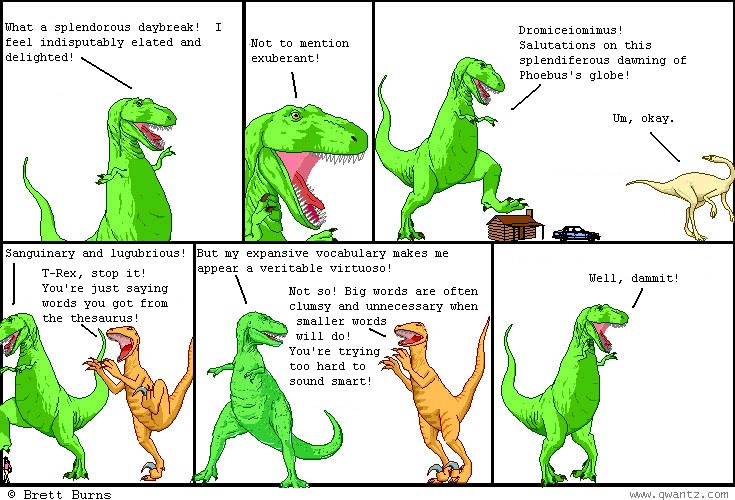
Jon, for his part, argues point A more often than anything -the fact that my word choices are going to cost me readers. Eventually, after several years of back and forth on this - the argument becoming more and more heated each time - we had to decide to agree to disagree. And the truth is this - the type of person who will want to read Mark's awesome post-apocalyptic vampire book is more likely to be akin to Mark in his or her preferences, and the person who will want to read my time travel 1920s British murder mystery is more likely to be akin to me.
But it brings up the question - what kind of reader are you? Are you on Team King, or Team Fry - or on a different team altogether? Do you like to encounter unknown words in your fiction, or do you prefer your story to flow, uninterrupted?
Weigh in now... !!
Q
Subscribe to:
Posts (Atom)


