Saturday, March 16, 2013

Transition


It’s – not quite spring.

You can tell it wants to be. I saw my first robin three weeks ago. The sun is strong and melty. The porters and stouts are slowly disappearing from the taps.

It won’t be long before buds will start to pop, coats will get stowed away, and our pale Minnesota skin will get its first splash of color.

Transition.

I wish I could say it was just the weather.

I’m very much a creature of habit – a fussy Virgo. I like my things just so. I like to know what I’m going to do each day. I want to know where I’m going to get my coffee. I don’t want the day to suddenly get one hour longer.

So why am I an IT consultant? Why do I have a job that can change on a dime, and take me to God only knows where?

Why am I choosing to move? Why am I cleaning out, digging through old memories, sorting away those I want to keep and wincing as I throw away those that no longer hold the meeting they once did?

And what am I doing with my writing? I’m so close to done – months away from being a bona fide published author – and yet my day job and the move pull me away and into chaos.

Transition.

And yet I’m thankful for all of it.

I’m blessed to work with good people, to have the means to move, and to have the time – however little it seems some days – to write.

Here’s to transition – and may it settle the fuck down.

Friday, March 1, 2013

A PRIMER


A PRIMER (for the zombie apocalypse)
by Mark Teats

During the zombie apocalypse, circle your house, inspecting that every board is hammered tight. Shutter the first floor windows, but not upstairs. Zombies are terrible climbers, and the sunshine will boost your spirits on those lazy afternoons. Inside, keep all unnecessary doors locked. Unlocked doors only invite zombies. Memorize your escape routes, load your guns, safeties are optional. Always wear shoes or better yet, boots. Cultivate relationships with slow runners. When crossing midnight playgrounds you may hear the laughter of shadow children echoing off the empty swing sets. Move quickly. If you are followed by ankle-biters, literally, do not spare the rod, for the child has already spoiled. Can’t you smell them? Apply your baseball bat liberally. Aim for the head. It’s the kind thing to do. But don’t strain yourself. You can’t afford a sprained arm or shoulder. 

For entertainment, books and comics are best. Archie, Howard the Duck, nothing too deep,  nothing too heavy. If you have a portable generator then a DVD player and a stack of Jim Carrey movies will really make all the difference, between wanting to go on, and wanting to put in a good movie. Laughter is the best medicine. It cures what ails us. Except for Zombie virus Z strain 17, apparently. Generators will call in zombies, so in the slow parts of  the show, you can take a break, and put a few down. With gunfire, no ethnic slurs, or criticism over fashion mistakes. They can’t help how they were made. 

After hand-to-hand mano y zombie combat, feel for fresh wounds. Strip down; leave your bloody clothes behind. The epidemic crawls there. Go to clean water. Bathe, pray, lather, repeat.  Bathe, pray, lather, repeat. Make visual confirmation  there are no cuts, scratches, bite marks or unwanted blemishes. Leave your feminine side behind. Makeup, lipstick, perfume, tears, shows and books about angst filled vampire love and clumsy teenagers don’t belong here. Nor English royalty. That bullshit is left behind. Don’t accept “new kinds” of meat from strangers. Be wary of strangers in general, especially those that drag their feet, moan, have rotted body  parts, and who wear cloying cologne. Beware, also, of the happy. There is no time for giggling now. Although, maybe it was just one of those Jim Carrey flicks that set them off. 

Know where to find fresh water. Reload. Know how to hunt, fish, camp, steal, read instructions, climb a light pole, deliver a spleen rupturing punch, and sew. Knitting is of no use. Knit garments get caught on things, like grabbing, gnarled hands, or yellow, infection-clotted teeth.

Sing. Something popular, preferably something mindless with Spanish or Korean lyrics. “Gangnam Style” comes to mind. Enjoy the new financial utopia. No one cares about your mortgage payment, your credit card debt or your money now. Gas tanks are best kept full. Slant the nose of your parked escape vehicle down the driveway, like a plane ready for a bumpy, emergency crash landing. Keep on eye on the exits, have piles of maps. Leave the GPS behind. They’ve become less and less stable since The End. 

Once you’ve killed all the zombies in your neighborhood, clear the land around your stronghold. 550 meters is the effective range of an M16 rifle. Fire is a good clearing agent for pesky buildings that block your view. Plant killer and dynamite have their places, too. Use as needed. Don’t think of zombies as humans. Sure, some of them were once like you. Once your friends, perhaps. But then some of them don’t give your books back (Nancy). Some of them spill soda on your rugs and don’t offer dry cleaning (Tony). I repeat: Zombies are not human. To think otherwise is dangerous, it’s loser talk.

 Cock. Aim. Fire. Reload. Cock. Aim. Fire. Reload. Know how many grains of gunpowder work best in a 9mm bullet. Six is best. You want that extra punch. Have a reload kit, 5,000 rounds of empty brass,  and five pounds of premium gun powder. One thing is still true as it was before the zombies: avoid condominiums. Three gallons of clean water per person is a good start, but you’ll be thirsty in no time. Consider a solar still. Do not make out after beating an undead mob to death with a hatchet. It’s icky. However, if you’ve taken all the above to heart, fornicate. A lot. In interesting positions. The best lookout on top. It passes the time. And unlike zombies, babies don’t make themselves. And without babies, this has all been for nothing.
     ~ Mark Teats / @manowords

*Explanation: This is my attempt at a "prose-poem." I hope you enjoyed it. 

**Watch out for zombies.


Friday, February 22, 2013

The Little Words Can Throw You Too

I've been pondering since Claudia's last post, this idea of interrupted reading, of writing that throws the reader out of the story. We often talk about that as a flaw in the writing. But in this post (and my next couple) I'm trying to get a handle on throwing out that, in some writing at least, is just right.

Sometimes I'm reading a story and the writing is so _______, I just can't go on. And rather than the negative adjective that your brain may have supplied there, I'm thinking about when the writing is so beautiful or lyrical that I just need to stop and read the line again. Or when an author has chosen the absolutely perfect word to capture a feeling that is very hard to describe in words.

My most recent experience of the later example comes from Ursula K. Le Guin's The Dispossessed, which I was reading when Claudia's blog went live.


Shevek has just landed on Urras, the lush planet from which his species evolved. Only he has never set foot on it. (Four? Six?) generations ago a dissident group of Urrasti emigrated to Urras's desert moon, Anarres. There has been next to no communication between the two civilizations since that time.  He is surrounded by photographers. Le Guin writes:

"The men around him urged him forward. He was bourne off to the waiting limousine, eminently photographic to the last because of his height, his long hair, and the strange look of grief and recognition on his face."

The strange look of grief and recognition.

Reading these words I was instantly there with Shevek, perhaps I was Shevek just a little bit. Here I am, standing for the first time on the planet from which my deepest ancestors evolved. I have the eyes I do, the skin, the perceptions, my entire body and likely a good portion of my mind, all of these are the way they are because my species came to be, here. Right here. And I have been separated from my body's truest home my entire life. I am for the first time smelling the trees, feeling the winds, seeing the colors of the sky, being embraced by the world that made me the sort of being I am.

Grief. Recognition.

With just those two words, Le Guin captured for me the ephemeral of coming home to a place that one does not know.

Grief. Recognition.

And I cannot read on, because I want to sit with that complicated emotional state awhile. And layered in that state is something more, is awe. My appreciation of Le Guin's ability to do this to me. How not only has she nailed it in two words, she's also given the sentence a meter that moves you to those two words and punctuates them. And again I just need some time.

And as I savor the moment, more layers stack up. Recognition. Grief. Recognition of writing at its best. Grief that I am nowhere even close to that ability.

Yet.


Friday, February 8, 2013

The Great Word Debate

All of us over at the Scribblerati watering hole get along remarkably well. I think this is the biggest reason why we've kept our group so small... adding another personality into the mix would risk endangering our sanguine dynamic.

Not to say we don't disagree on things. If we didn't bring diverse points of view to the table, we wouldn't be much of a critique group - we'd have to rename ourselves "Preaching to the Choir," or "You Guys are the Best" (said with a drunken slur).


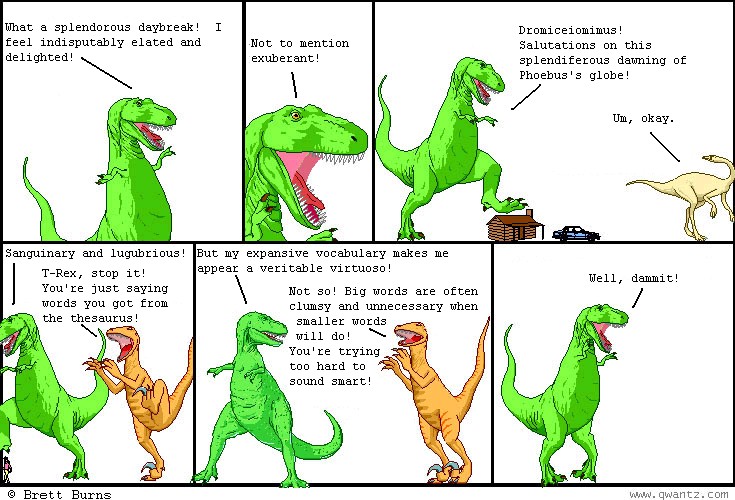
The one disagreement that keeps coming up again and again is the Great Word Debate. I like me some big words. Not ridiculously out-of-place, big-for-the-sake-of-being-snooty words - but words that either are A) Very specific and therefore exactly right for the moment, B) Fit rhythmically into the sentence, or C) are charming and funny. Some other members of the group, however, disagree with the use of unusual words in writing. They quote Stephen King, who noted that (paraphrasing here) any word that stops the reader in his or her tracks should be removed, as it gets in the way of the story. I quip back that I'm less on team Stephen King, and more on team Stephen Fry - a man who uses a heck of a lot more outré words than I.


For example, in my book, Ursula Evermore and the Case of the Man Who Wasn't, I use the following words: circumnavigate, parsimonious, collywobbles, and uxoricide.  Mark, in particular, has objected to every one of these words, and more. At most, I have one of these per chapter, and probably less often then that.

My arguments:
A) Many people do know these words. I know them, after all - and it won't stop the flow of the story for these people.
B) If the reader doesn't know the words - then they can either look them up, or try and glean their meanings from the surrounding text. After all, in this modern age, the answer is often only a right click or a touch away. This is how I learn new words - I read them in a story, book or article, and I look them up. Heck, several years ago I learned the word 'sartorial' from Entertainment Weekly - hardly a highbrow publication.

Mark's side:
A) He's right, there are many people who will come across a so-called 10 dollar word, and because of frustration, or thinking the author is being pretentious, will put down the book.
B) Sometimes you're just in the mood to read something with a good story and characters, and you don't want to have a dictionary by your side.
C) People who abuse the thesaurus are annoying.


Jon, for his part, argues point A more often than anything -the fact that my word choices are going to cost me readers. Eventually, after several years of back and forth on this - the argument becoming more and more heated each time - we had to decide to agree to disagree. And the truth is this - the type of person who will want to read Mark's awesome post-apocalyptic vampire book is more likely to be akin to Mark in his or her preferences, and the person who will want to read my time travel 1920s British murder mystery is more likely to be akin to me.

But it brings up the question - what kind of reader are you? Are you on Team King, or Team Fry - or on a different team altogether? Do you like to encounter unknown words in your fiction, or do you prefer your story to flow, uninterrupted?

Weigh in now... !!

Q

Friday, February 1, 2013

Truthiness in Writing


As a teenager I occasionally watched the TV show, The Dukes of Hazard. Please don’t hate me for it. It was 1979 and good TV hadn’t been invented yet.

To me, all the episodes of ‘Dukes kind of blend together, with lots of formulaic moments. Uncle Jesse spouting some sort of country wisdom, Daisy Duke in her ‘ahem’ “Daisy Dukes,” and almost without fail, the Duke-boys’ car, the General Lee, jumping yet another ravine or washed out bridge, driving on unharmed, safe on the other side of the jump. But it was that moment, as the General Lee landed and drove on, that I was always thrown out of the episode, thinking: No one could walk away—let alone drive away—from that car jump. It would end more like this. (Apparently 150 General Lees were destroyed over the lifespan of that show.)
How the General Lee would look after landing a few of those jumps
Similarly, in the movie Independence Day, earth scientists program an Apple computer (in a few hours) to deliver a virus to an alien computer that will shut down all their space ships and literally save the day.
Meanwhile from my Mac I send out a .docx file (instead of a .doc file) to my friend on another Mac computer. He can’t open my file. It's not compatible enough. Game over man.

And, in the recent movie The Hobbit (pt 1--which I actually did enjoy), there is a scene under the mountain where the dwarves go through an action sequence that defies gravity and all probability as they run from a mob of hundreds of goblins and then fall thousands of feet down a cliff riding a rickety pile of wood, only to land safely and unharmed. They get up, the unexpected journey continues….
I leave to pee. No character is in any immanent danger. Jr. Mints at the concession stand are in order, too. No need to hurry back. When I return, the dwarves will be putting together an Ikea dresser. If they can survive that fall, they'll survive everything else they encounter, too.

So what I’m trying to say here is that when believability, or maybe even truth, is violated in a story, you as the reader/viewer find yourself questioning what just happened and are no longer following the story.

The opposite can also sometimes happen in writing, too. Sometimes it’s the real things that lose people’s interest, or take them out of the story.

A few months back I was working on a short horror story called “Trotline.” Part of the story is about vampires. Part of it is a series of flashbacks about a teenager working fishing trotline for extra money with his father. One of the comments that I got back in my critiques surprised me. In summary: “No one would do all this work to sell fish for 50¢ a pound. Not in Minnesota!” But as it turns out, that aspect of the story was very autobiographical for me. One year as a teen I did work a trotline and sold the fish for pennies on the pound—in Minnesota (it was fun with lots of cool moments, but really made no money at all). So the part of my story that was true, that I had lived through—wasn’t believable—and it didn’t jive with what seems real in today’s world. But yet, it did happen. I lived it. When I finally rewrite my short story (it’s in my editing stack) I’ll listen to that critique—and I will be rewriting some of the “real” details to further fictionalize this actual part of the story. Then maybe it will fit in and feel “real” and not trip my readers. The one improbably element of my short story that no one questioned? Vampires.

In the fall of 2011 I attended a novel writing conference at the Loft. The keynote speaker, Pam Houston, talked a lot about truth in writing. She writes short stories, essays and memoir. She told a very funny story of how once while working for a magazine as a travel writer, she wrote and sold a travel piece about canoeing in France. In one segment of the story she told of flirting with another canoe full of Italian men on a beautiful stretch of river. The “fact checker” (do such jobs still exist in 2013?) for the magazine phoned her, questioning some of the details of the article. Pam admitted she had embellished some of it—but the magazine liked it and published her article. In particular the magazine fact-checker said that they loved the part in her article where Pam flirted with the hunky, Italians. The truth, the real truth, she admitted, was that she’d made up the whole story. The weather in France that time of year was rainy and dreadful. She’d never set foot in a canoe during her entire trip—and despite how well she’d written them, there were never any hunky Italian guys to flirt with.

At the end of her presentation (and I hope I’m quoting correctly) Pam Houston said that when she wrote memoir, she believed about 82% of what she wrote was real or the “truth.” When writing fictional stories she believed that about 82% of what she wrote was the “truth.”

What is real in your work that nobody will believe?

What is fictional in your work that no one will question?

Wishing you real writing—or better yet unreal writing.

Mark
@manowords

Note: for more on reality in writing, please keep scrolling to see Lisa’s excellent piece below!


Friday, January 25, 2013

Inspiration/Condensation

tasty x ten
I had an inspired meal this week. My sweetie brought me to Travail in Robbinsdale, thinking I'd like it, but a bit worried I'd find it too loud. (It was loud, but with a mix inspired by Gnarls Barkley, I wasn't complaining.) However, it turns out, I didn't like the place.

I adored it. Best dinner out. Ever.

The food is strange, lovely, unexpected, silly, and (literally, in some cases) bursting with flavor. The parsley gel in the rutabaga soup was a bright green, velvety, hillock of pure parsley flavor. A narrow, plastic tube that surely was intended for science experiments, filled with who knows what (cream, lime, fresh thyme, and....?) Moonrocks! Frozen blue rocks that tasted of raspberries and had us breathing out white clouds of breath vapor through our noses. I ask, when was the last time you got to be a dragon at the dinner table?

We'd gotten the vegetarian version of the eight course tasting menu, which included more than eight courses, plus at least four amuse bouche/palette cleansers. The waitstaff are the chefs. The chefs are jazzed by what they do. You get to watch them as they push each other take food and turn it into magic. They bring you their pride and joy. The woman sitting nearest us was giddy with every dish they brought her. I was charmed beyond all belief. Everyone seemed swimming in joy.

Where this connects with writing is here: I've been playing with the idea that that meal was not real.

I don't mean "It was unreal how good it was," tho' it was very, very good. Instead, I mean that it took a real pear and turned it into fantasy, into science fiction. It became an exaggeration of a true pear, a condensation, compressed down to its essence.

And that's a lot like writing. We don't recreate real experiences, real lives. Real lives are filled with fluff, and sleep, and all those dull moments in between. When we write we condense reality down so we can taste the powerful stuff of lives more clearly, more distinctly, more powerfully. It's a heady experience, writing is. At it's best it can thrill us all the way down to the marrow of our bones.


Friday, January 18, 2013

Take Off Your +3 Cloak of Isolation


Cross posted from my blog, Writing and Whatnot

------------------

It should come as no surprise to anyone that we writers are a relatively solitary bunch. Regardless of how outgoing we are in our everyday lives, we have to shut away the world to write.

And we like it.

Writers get high from a brilliant plot twist or off the buzz of a perfectly crafted sentence in the same way normal people do from partying with their friends. Ok, writers do that too, but we just do it less often, and even when we are with friends, our minds aren't all that far away from our story, or the possibility of story laying nascent in the gestures of the woman across the aisle, or in the way the light shines through the window and onto the bar.

We writers know that constant churn of creativity is gold. It can only come from within our minds and only we can spit it out onto paper. We have to do it, and we have to do it alone. No one can do it for us.

And that’s where we get into trouble.

Consider all those indie publishers out there. Some of them find success but a lot of them don’t. Now take a look at all those “real” authors out there. They may have the vindication of being published, but we all know that’s no guarantee of financial success. Regardless of our path, the problem all us writers face is the same: How do I become successful?

Yes, we all know the road to success is long and winding, and while we all face the challenges of editing and marketing, we indie authors have one defining challenge that will separate those who fall flat on their face and those who go on to find success: knowing when you are ready.

Now I can’t speak for all writers, but after accomplishing as much as I have, I’m pretty impressed with myself. I kinda think I’m the shit, you know? And I am. I’m pretty damn good. But I’m not ready for the Big Show. Not yet. Not quite.

My writing group (Scribblerati Agents unite!) didn't tell me that. Nor did I wake up knowing that. My editor told me. She didn't come out and say, “Shawn, you handsome, egotistical bastard, you've got something here but you aren't ready to publish.” What she did was point out all the things I need to work on, which in turn saved me from joining the ranks of those indie publishers who publish too early.

So allow me to pass along a little advice. If you, like me, are one of those lonely indie writers who are preparing to knock on publishing’s front door, then start talking to other people in the industry. Make connections beyond the immediate focus of your peer groups. Stretch yourself. Challenge your certainty and make certain that you really are the shit. Find those people who can help with the next stage of your evolution.

The Big Show is waiting. Take off your +3 Cloak of Isolation, get the help you need, and make your entrance with style.